

Play-Based Learning vs Traditional Preschool Learning
Verdict
Play-based learning is generally better for integrating language, thinking, self-regulation, social development and early concepts through active experience. Traditional preschool learning is useful when children need a clear demonstration, concise explanation or focused practice of a specific skill.
Choose a play-based programme if: You want broad development through exploration, guided play, projects, conversation and meaningful routines.
Choose a more traditional method if: The immediate goal is efficient instruction in a clearly defined fact, rule or procedure, provided the teaching remains age-appropriate and does not take over the day.
Bottom line: For most preschool children, the strongest approach is an intentional play-based programme that uses direct teaching selectively rather than treating play and instruction as mutually exclusive.
Summary
Play-based learning gives children meaningful choice and uses activity, interaction and inquiry to develop connected skills.
Traditional preschool learning is usually more adult-directed, with predetermined tasks, explicit teaching and standardised products or responses.
Research does not support a simple claim that one method wins every outcome; guided play shows advantages for some mathematics, spatial and executive-function outcomes, while direct instruction can efficiently teach specific content.
Programme quality depends on teacher skill, relationships, curriculum balance and responsiveness, not on a marketing label.
Parents should ask how the programme protects play, teaches foundational skills, adapts for individual children and documents progress.
Play-Based Learning vs Traditional Preschool Learning at a Glance
Factor | Play-based learning | Traditional preschool learning |
|---|---|---|
Main learning route | Exploration, interaction, representation and guided discovery | Explanation, demonstration, repetition and predetermined tasks |
Child role | Active participant with meaningful choices | Listener or performer following adult-selected directions |
Teacher role | Designer, observer, guide, modeller and selective instructor | Primary source of knowledge, director and evaluator |
Curriculum flow | May develop through interests, projects and planned learning goals | Usually follows a fixed sequence or timetable of content |
Learning evidence | Conversation, strategy, observation, work samples and application | Correct responses, completed tasks, recitation and written products |
Social learning | Often embedded in shared play and projects | May occur in group lessons but can be secondary to individual work |
Early academics | Integrated into meaningful contexts with targeted instruction | Taught directly and practised through structured exercises |
Pace | Flexible within curriculum goals | More uniform across the group |
Main strength | Connected development and application | Clarity and efficiency for specific skills |
Main risk | Weak implementation can become aimless activity | Overuse can reduce agency, movement, deep play and flexible application |
Best fit | Young children who learn through action, talk and relationships | Short focused instruction or children who benefit from explicit modelling |
The table describes tendencies, not absolute categories. Many effective preschools combine approaches. A programme may be play-based overall and still teach a letter formation or safety procedure directly. Another may use a structured timetable while including meaningful projects and child choice.
What Is Play-Based Learning?
Play-based learning uses play as a central context for developing knowledge, skills and learning dispositions. Children may build, pretend, investigate, create, move, tell stories or play games. The experience includes genuine participation rather than a worksheet decorated as a game.
In free play, children largely choose the direction and purpose. In guided play, an adult has a learning goal and supports the experience through materials, modelling, questions or hints while preserving meaningful child agency.
NAEYC defines developmentally appropriate practice as a strengths-based, play-based approach to joyful and engaged learning. It also states that teaching may include self-directed play, guided play, direct instruction and routines, adapted to the child and context. (NAEYC, accessed 2026; NAEYC teaching guidance, accessed 2026)
Pitter Patter describes its own approach as Play Inquiry Multilingual. Its first-party explanation presents children as constructors of knowledge who follow interests, ask questions and develop understanding through exploration, with Bahasa Malaysia and Mandarin included in the multilingual environment. (Pitter Patter Early Learning Centre, accessed 2026)
The defining feature is not the absence of adults. Strong play-based teaching is intentional. Educators decide what experiences may support learning, observe children's strategies and intervene when support can extend thinking, safety or participation.
What Is Traditional Preschool Learning?
Traditional preschool learning usually refers to adult-directed teaching in which the teacher selects the content, method, pace and expected response. Common practices include whole-group explanation, demonstration, recitation, flashcards, tracing, worksheets and repeated exercises.
The term is broad. Some traditional practices are brief and useful. A teacher may directly explain how to hold scissors safely, model a sound-symbol connection or demonstrate a counting strategy. Other programmes make adult direction the dominant mode, leaving little time for child-led exploration, extended conversation or physical play.
Direct instruction has a legitimate educational purpose. Clear modelling reduces ambiguity and can make an important step accessible. Problems arise when the method is applied to nearly every goal, when children reproduce answers without understanding or when age-appropriate movement and play are treated as rewards after "real learning."
The comparison should therefore focus on proportion and quality. The question is not whether a teacher ever gives an instruction. It is whether the overall programme allows children to think, choose, apply, communicate and develop across domains.
Play-Based Learning vs Traditional Preschool Learning for School Readiness
School readiness includes basic skills, but it also includes participation. Children need growing language, attention, self-regulation, independence, social competence and confidence in approaching unfamiliar tasks.
Malaysia's Ministry of Education states that preschool should develop children's potential in all areas, support mastery of basic skills and cultivate positive attitudes in preparation for primary school. (Ministry of Education Malaysia, accessed 2026) This broad goal aligns poorly with any programme that reduces readiness to early worksheet completion.
Play-based learning can integrate readiness demands. A group project may require children to listen, plan, count, draw, negotiate and clean up. The child uses skills together, as school and life later require.
Traditional teaching can help make a specific expectation clear. A short small-group lesson may introduce letter-sound knowledge or show how to organise materials. The risk is mistaking performance under adult direction for independent readiness. A child may complete a familiar page but struggle to choose a strategy, explain thinking or cope when the format changes.
Comparison verdict: Play-based learning has the stronger structure for whole-child readiness. Selective direct teaching strengthens it when used for clear, specific purposes.

Play-Based Learning vs Traditional Preschool Learning for Language and Literacy
Play-based settings generate extended reasons to speak. Children negotiate roles, tell stories, explain plans and use language to solve social problems. Books and writing can enter play through menus, signs, labels, maps and messages.
Traditional approaches can explicitly teach alphabet knowledge, sound awareness, print conventions and handwriting movements. Clear modelling is valuable, especially when a child needs a concept made visible.
The risk in an overly traditional programme is decontextualised repetition. Naming letters does not automatically produce comprehension, vocabulary or narrative ability. Copying a sentence does not prove the child can form and communicate an original idea.
The risk in a weak play-based programme is assuming that exposure is enough. A print-rich room does not guarantee that teachers notice sounds, model writing, discuss books or track progress.
The What Works Clearinghouse practice guide Preparing Young Children for School recommends intentional instruction in vocabulary, language, sound awareness, letter knowledge and shared book reading, alongside recommendations for social-emotional and executive-function development. (Institute of Education Sciences, 2022)
Comparison verdict: Combine rich conversation, stories and meaningful writing in play with explicit, developmentally appropriate literacy teaching. Neither worksheets alone nor unguided exposure is sufficient.
Play-Based Learning vs Traditional Preschool Learning for Mathematics
Play-based mathematics appears when children count for a purpose, compare length, create patterns, sort by attributes, build with shape and measure during projects. Guided play lets a teacher focus attention with a prompt such as, "How many more do we need?" or "What makes these two groups equal?"
Traditional teaching may introduce number symbols, procedures and mathematical vocabulary directly. Repetition can help consolidate a strategy after the child understands it.
A 2022 systematic review and meta-analysis included 39 guided-play studies, with 17 contributing to meta-analysis. It reported positive effects of guided play compared with direct instruction for early mathematics, shape knowledge and task switching, and compared with free play for spatial vocabulary. It found no clear differences for several other outcomes and noted substantial variation across studies. (Skene et al., Child Development, 2022)
This evidence is promising but not a universal verdict. It suggests that guided play can combine a clear goal with active child involvement, particularly for concepts that benefit from manipulation and spatial reasoning.
Comparison verdict: Guided play is often the stronger first route for mathematical relationships. Direct explanation and focused practice are useful when they clarify and consolidate rather than replace understanding.
Play-Based Learning vs Traditional Preschool Learning for Executive Function
Executive function includes working memory, impulse control, flexible thinking and planning. Children use these skills to follow instructions, manage transitions and persist with learning.
Play can place executive function inside a meaningful challenge. Pretend play requires children to remember roles and rules. Construction requires planning and revision. Movement games require stopping, starting and switching responses.
The Center on the Developing Child at Harvard University explains that executive-function and self-regulation skills develop through interactions and practice. Its activities for ages three to five include imaginary play, storytelling, movement challenges, songs and games with rules. (Center on the Developing Child at Harvard University, 2014)
Traditional classroom routines can also exercise attention and memory. Children may listen, follow a sequence and complete a task. However, a highly controlled environment can hide self-regulation because the adult regulates every choice and movement.
Comparison verdict: Play-based experiences provide more varied practice in planning and adapting. Brief structured tasks can strengthen attention, but children also need opportunities to regulate themselves rather than only comply under close direction.
Play-Based Learning vs Traditional Preschool Learning for Social and Emotional Development
Shared play creates real social problems. Children decide how to enter a game, share materials, handle rejection, change roles and repair conflict. Teachers can coach language and set safe limits without solving every disagreement.
Traditional whole-group lessons may teach feeling words, rules or expected behaviour directly. This can provide a common language. The limitation is that knowing the rule is not the same as applying it when a desired toy is unavailable.
The American Academy of Pediatrics links play with social-emotional development, self-regulation, nurturing relationships and resilience. Its clinical report was reaffirmed in 2025. (American Academy of Pediatrics, 2018, reaffirmed 2025)
An overly permissive play environment can still fail children if adults ignore exclusion, aggression or repeated conflict. Effective play-based teachers observe, protect safety and teach replacement skills.
Comparison verdict: Direct teaching can name a social skill, but play is where children practise it under realistic conditions. The combination is stronger than either alone.
Play-Based Learning vs Traditional Preschool Learning for Creativity and Problem-Solving
Play-based experiences often allow more than one possible outcome. A child can design a structure, invent a story, represent an idea with different materials or test several solutions. This develops divergent thinking and comfort with revision.
Traditional tasks often define the correct product in advance. That structure can be useful when the purpose is learning a specific technique. A model may show how to fold paper, use a tool or form a symbol.
The risk appears when every artwork must match the teacher's sample and every question has one expected route. Children may become skilled at waiting for instructions rather than generating ideas.
The opposite risk also exists. Giving materials with no guidance does not guarantee deep creativity. Children may repeat a familiar action because they lack technique, language or confidence. A teacher can model one possibility and still return ownership of the design.
Comparison verdict: Play-based learning better supports original planning and multiple solutions. Traditional demonstration is useful as a tool, not as the required outcome for every child.
Play-Based Learning vs Traditional Preschool Learning for Physical Development
Young children need movement. Outdoor play, climbing, dancing, carrying, drawing, cutting and manipulating materials develop coordination and body awareness.
A traditional programme may include physical education and fine-motor exercises but still ask children to sit for long periods. Sitting quietly can be a useful short-term skill. It should not become the main proof of learning or readiness.
Play-based environments more naturally integrate movement with thinking. Children carry blocks, act out stories, measure outdoor distances and use tools in projects.
Comparison verdict: Play-based learning offers broader daily movement. Structured instruction still matters for safe tool use and specific movement techniques.
Play-Based Learning vs Traditional Preschool Learning for Assessment
Traditional assessment often produces visible evidence: completed worksheets, correct answers and standardised tasks. This can make comparison straightforward, but it captures performance in a particular format.
Play-based assessment relies more on observation, conversation, photographs, work samples and documentation over time. It can reveal strategy, language, persistence, interaction and transfer. It also requires teacher skill and careful recording.
A balanced assessment system may include both:
Observation during natural and guided experiences.
Individual conversation or demonstration.
Work samples collected over time.
Short focused tasks for particular knowledge.
Family information about behaviour across settings.
Parents should ask what teachers notice, how observations influence planning and how concerns are followed up. A folder full of crafts is not the same as assessment. A page of ticks is not the whole child.
Comparison verdict: Play-based assessment gives richer contextual information, while focused tasks can clarify a specific question. Multiple sources produce a more trustworthy picture.
Where Play-Based Learning Is Stronger
Integrated development: One experience can connect language, mathematics, movement, self-regulation and social learning.
Meaningful application: Children use ideas to solve a problem or communicate, not only reproduce an answer.
Agency and motivation: Children have a real role in shaping activity and are more likely to sustain involvement.
Flexible thinking: Open-ended experiences invite revision and more than one possible solution.
Social practice: Shared play creates authentic opportunities to negotiate, cooperate and repair conflict.
Observation of process: Teachers can see how a child plans, adapts and seeks help.
Where Traditional Teaching Is Stronger
Clear demonstration: A teacher can show a safe, efficient or conventional way to perform a specific action.
Explicit language: New terms, rules and symbols can be introduced precisely.
Focused practice: A child can repeat a narrowly defined skill after understanding it.
Immediate correction: Misunderstandings that create safety or foundational errors can be addressed directly.
Predictable sequence: Some children benefit from clearly staged steps and a visible endpoint.
These strengths explain why effective play-based programmes do not ban direct teaching. They place it inside a broader developmental design.
Risks of Poor Implementation
When Play-Based Learning Is Poorly Implemented
Adults provide little observation or guidance.
Materials are available, but children wander without deep involvement.
Teachers use the label "child-led" to avoid planning.
Foundational skills are assumed to appear without intentional support.
Dominant children control shared play while others remain excluded.
Documentation celebrates activity without showing learning.
When Traditional Preschool Learning Is Overused
Children spend long periods sitting and waiting.
Correct-looking products matter more than understanding.
Worksheets replace conversation, movement and experimentation.
All children follow the same pace regardless of readiness.
Mistakes become something to avoid rather than information for learning.
Compliance is mistaken for attention, independence or motivation.
Quality must be judged through practice. NAEYC's family guidance identifies both aimless, disorganised activity and excessive adult control as warning signs. (NAEYC, accessed 2026)
Which Approach Should Parents Choose?
Choose an intentionally play-based programme if you want:
Broad whole-child development.
Extended conversation and social interaction.
Investigation, projects and open-ended materials.
Teachers who guide without controlling every outcome.
Early academic concepts used in meaningful contexts.
Value selective traditional instruction when your child needs:
A concise explanation of a specific rule or concept.
Clear modelling of a tool or procedure.
Short, focused practice after understanding.
Predictable steps that reduce unnecessary confusion.
Be cautious of either label if:
Staff cannot explain what children are learning.
Teacher-child relationships are weak.
Safety and supervision are unclear.
The programme cannot adapt for individual needs.
Evidence of progress is limited to marketing language.
The best question during a visit is not, "Are you play-based?" Ask, "Can you show me how children learned language, mathematics, self-regulation and social skills through yesterday's experiences, and where teachers used direct instruction?"
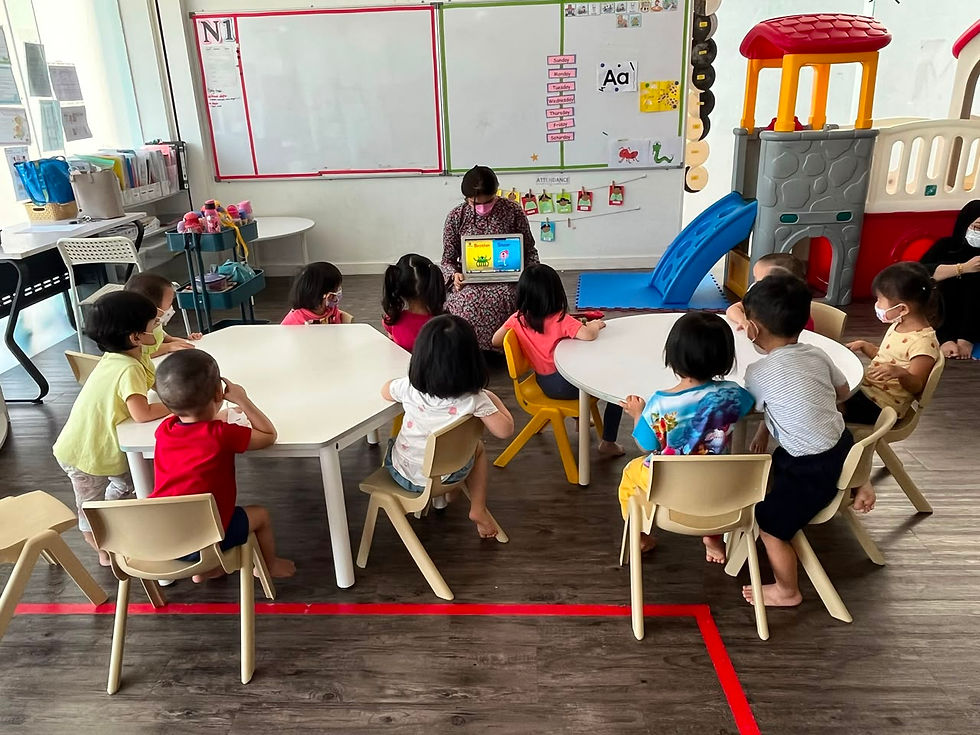
What a Balanced Preschool Day Can Look Like
A balanced day may include:
A predictable arrival routine with choices.
Extended play or inquiry in a prepared environment.
Teacher interaction with individuals and small groups.
Shared stories, songs and discussion.
Short explicit teaching tied to current learning.
Outdoor movement and exploration.
Meals, rest and self-care routines.
Documentation, reflection and revisiting ideas.
The proportion changes with age, group needs and programme goals. The principle remains: children need enough uninterrupted time to become deeply involved, and teachers need enough intentionality to ensure important learning is not left to chance.
Common Myths About the Comparison
Myth 1: Play-Based Learning Has No Academics
Play can include counting, language, print, measurement and scientific reasoning. High-quality programmes also teach specific skills directly when useful.
Myth 2: Traditional Teaching Always Produces Faster Learning
It may produce faster performance on the taught format. That does not automatically show understanding, transfer or long-term engagement.
Myth 3: Children Should Choose Everything in a Play-Based Programme
Teachers set safety limits, routines, curriculum goals and social expectations. Meaningful choice exists within a designed environment.
Myth 4: Direct Instruction Is Developmentally Inappropriate
Brief, clear and responsive instruction can be appropriate. The concern is excessive duration, abstraction or replacement of active learning.
Myth 5: A Hybrid Programme Is Automatically Best
Combining weak play with weak instruction does not create quality. The methods must be intentional, connected and responsive.
Frequently Asked Questions
Is Play-Based Learning Better Than Traditional Preschool Learning?
Play-based learning is generally stronger for connected whole-child development and meaningful application. Traditional direct teaching is useful for specific knowledge, rules and procedures. A high-quality preschool usually combines intentional play with selective explicit instruction.
Will a Play-Based Preschool Prepare My Child for Primary School?
Yes, when the programme intentionally develops language, early literacy and mathematics, executive function, social competence, physical skills and independence. Ask how teachers plan, observe and document those areas.
Are Worksheets Bad for Preschool Children?
An occasional focused page is not automatically harmful. Problems arise when worksheets take over, are developmentally mismatched or replace richer conversation, movement and practical experience.
How Can Parents Tell Whether Play Is Purposeful?
Look for sustained involvement, decision-making, conversation, problem-solving and revisiting. Ask teachers what goal informed the environment, what they observed and how they extended the learning.
What If My Child Likes Structured Lessons?
Predictability can be valuable. A play-based programme can still use visual routines, clear steps and small-group teaching. The child should also have supported opportunities to make choices, move, imagine and collaborate.
Does Play-Based Learning Mean Children Can Do Whatever They Want?
No. Teachers maintain safety, respectful behaviour, routines and curriculum intentions. Children have agency within boundaries and receive guidance when their actions affect others.
Final Answer
The most accurate conclusion in the play-based learning vs traditional preschool learning comparison is that preschool children need active, relational and meaningful learning, supported by clear teaching when clarity matters. Play-based learning should form the foundation because it integrates development and application. Traditional instruction should serve that foundation by making selected skills and expectations explicit.
Related Articles
Sources
NAEYC: Teaching to Enhance Each Child's Development and Learning
NAEYC: What Does a High-Quality Preschool Programme Look Like?
Institute of Education Sciences: Preparing Young Children for School
Skene et al.: Guided Play Systematic Review and Meta-Analysis
Center on the Developing Child at Harvard University: Executive Function Activities Guide


Comments