

How to Evaluate a Preschool Visit and Trial
To evaluate a preschool visit and trial, observe what children and teachers actually do, not only what the centre says during a tour. Look for warm and respectful interactions, active supervision, purposeful play, clear routines, suitable challenge, calm behaviour guidance and honest family communication. Then compare those observations with your child's needs and your family's practical requirements. A polished classroom can make a good first impression, but the daily relationships, systems and responses to ordinary difficulty reveal much more about quality.
Quick Answer: Prepare a short list of non-negotiables, visit while the programme is operating, watch teacher-child interaction, inspect the full daily environment, ask scenario-based questions and use the trial to assess support rather than performance. Record evidence soon after each visit so that friendliness, decor or sales language does not outweigh what you observed.
Summary
Evaluate a preschool by combining direct observation, specific questions, written policies and your child's response over time.
Give the greatest weight to relationships, safety, supervision, teaching quality, routines and communication.
Treat a trial as a sample of how adults welcome, guide and comfort your child, not as an entrance examination.
Ask what happens in difficult situations, including separation distress, conflict, illness, toileting accidents and delayed pickup.
Compare centres using the same criteria, while allowing for differences in programme philosophy and your child's temperament.
What You Need Before the Preschool Visit
Bring a focused checklist, a few notes about your child and enough time to observe without rushing. If two adults will make the decision, agree on the main criteria before the visit so that one person is not judging curriculum while the other is judging parking.
Define Your Child's Needs
Write down information that could materially affect fit:
Your child's age and previous group-care experience.
Languages understood and used at home.
Separation patterns and common comfort strategies.
Medical, allergy, dietary, toileting or developmental needs.
Strong interests, sensitivities and situations that commonly overwhelm the child.
The type of support your child currently needs to communicate, join play or manage routines.
Do not present these notes as defects. They help the centre explain how it would support the real child, rather than an imaginary easy child.
Define Your Family's Practical Limits
Clarify operating hours, travel time, budget, holiday coverage and who is authorised to collect your child. Pitter Patter's programme page, for example, publishes half-day, extended-day and full-day options for different age groups, with the longest listed day ending at 6:30 p.m. (Pitter Patter Early Learning Centre, accessed 2026) Parents should still confirm current availability, fees, late-pickup arrangements and programme-specific details directly because website information can change.
Choose Five Non-Negotiables
A long checklist can make every detail look equally important. Select five conditions that must be met, such as:
Safe supervision and controlled collection procedures.
Teachers who respond warmly and respectfully.
A learning approach that suits your child.
Hours and location that work consistently.
Clear communication about wellbeing and progress.
After these are satisfied, compare preferences such as class aesthetics, optional enrichment and convenience features.
Step 1: Visit While Children and Teachers Are Present
An empty-centre tour shows facilities. An operating visit shows the programme. ChildCare.gov recommends visiting in person because families can see how the setting runs, what a typical day looks like, how teachers interact and what classroom and play spaces are like. (ChildCare.gov, accessed 2026)
Ask whether you can observe part of a normal period without disrupting the children. A centre may reasonably protect children's privacy, limit filming and manage where visitors stand. The goal is not unrestricted access. It is a credible opportunity to see everyday practice.
Notice the overall emotional climate before focusing on individual details:
Are most children involved in something meaningful?
Do teachers appear attentive rather than constantly occupied with administration?
Is the room busy but organised?
Can children seek help without being ignored or shamed?
Do adults speak in a calm tone, including during transitions?
One crying child does not prove that a centre is poor. Young children cry for many reasons. The useful evidence is how adults respond and whether other children remain secure and engaged.

Step 2: Observe Teacher-Child Relationships
Relationships are a core quality indicator because young children learn through interaction. NAEYC describes high-quality preschool teachers as warm and caring, interested in each child and family, supportive of friendship and attentive to full participation. (NAEYC, accessed 2026)
Look for Respect at the Child's Level
Watch whether teachers use children's names, make eye contact, listen to incomplete explanations and get physically closer when appropriate. ChildCare.gov's visit guidance suggests noticing whether caregivers speak at children's eye level and show interest in what children are doing. (ChildCare.gov, 2022)
Respect does not mean children decide everything. Teachers can set limits firmly while preserving dignity. Compare these two responses:
"Stop that now. You're being naughty."
"I won't let you push. Tell her you want a turn. You can wait here or choose another piece."
The second response identifies the limit, protects the other child and teaches an alternative.
Listen to the Questions Teachers Ask
Quality interaction goes beyond praise. Notice whether teachers ask children to describe, predict, compare and explain. A teacher might say, "What do you think will make it stronger?" instead of building the structure for the child.
NAEYC's developmentally appropriate practice guidance places responsibility on educators to make experiences stimulating, engaging and responsive across developmental domains. It includes self-directed play, guided play, direct instruction and routines within the teacher's repertoire. (NAEYC, accessed 2026)
Observe How Teachers Share Attention
A charismatic teacher leading one attractive activity may draw your eye. Look also at children at the edges of the group. Does someone notice the quiet child, the new child, the child who needs the toilet or the child repeating an action without progress?
Ask how staff divide responsibilities during arrival, meals, outdoor play, toileting and departure. Supervision quality often depends on these transitions, not only on the headline staff-child ratio.
Step 3: Inspect Safety, Health and Supervision in Context
Safety is more than a locked gate. It is a system of environment, routines, staff awareness and response.
Inspect the Physical Environment
Look for:
Controlled entry and a clear collection process.
Clean, usable toilets and handwashing areas.
Age-appropriate furniture and materials in good repair.
Clear walking paths and secured hazardous items.
Safe outdoor surfaces, shade and maintained equipment.
Visibility that allows adults to supervise without blind spots.
Accessible emergency information and first-aid arrangements.
Sensible storage for medicines, cleaning materials and children's belongings.
Do not expect a showroom. A lived-in classroom may have works in progress and children's materials in use. Distinguish productive activity from preventable hazard.
Ask About Safety Scenarios
Scenario questions produce more useful answers than "Is the centre safe?" Ask:
What happens if an unauthorised adult arrives for pickup?
How do you manage headcounts when moving between spaces?
What is your process after an injury?
When must a sick child stay home, and how are families informed?
How are allergies and medications managed?
What training do staff receive for emergencies and first aid?
How do you supervise toileting without compromising privacy?
Request relevant written policies. A confident centre should be able to explain who is responsible, what is recorded and when parents are contacted.
Check Whether Practice Matches the Answer
If the centre says children wash hands before meals, observe whether the routine occurs. If it says pickup is controlled, notice whether staff identify arriving adults. One short visit cannot audit every process, but consistency between explanation and visible practice increases confidence.
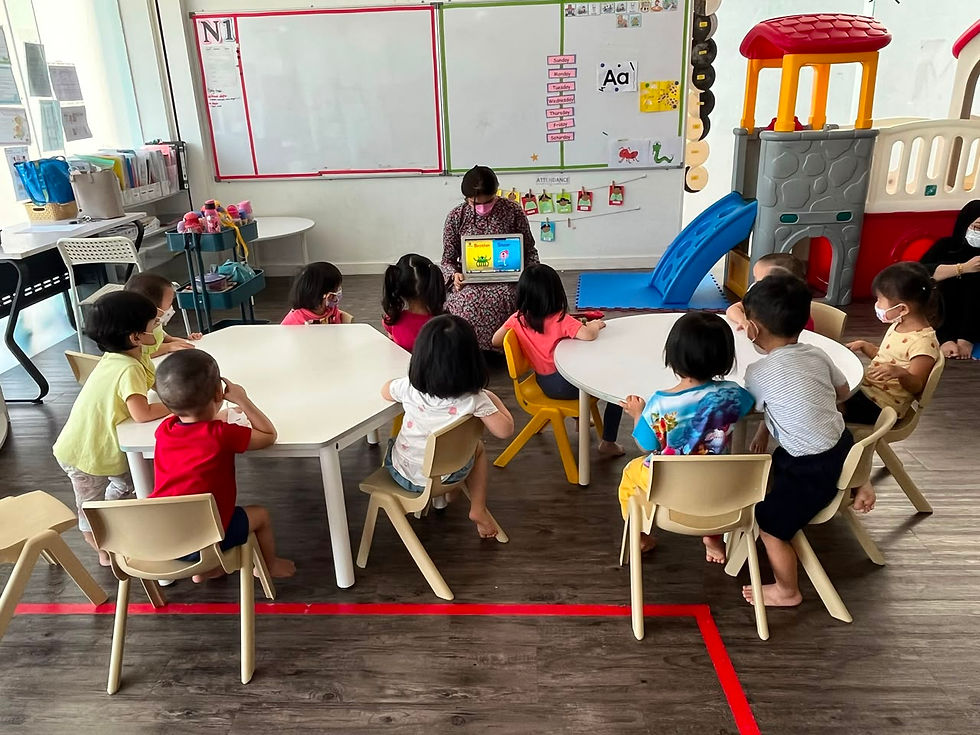
Step 4: Evaluate the Learning Environment
A high-quality learning environment gives children something meaningful to do and adults who know how to extend it.
Look for Variety and Depth
The environment should support different kinds of engagement: stories, conversation, construction, pretend play, art, movement, sensory exploration, early mathematics, outdoor activity and quiet retreat. Materials should be accessible enough for children to make choices within safe boundaries.
ChildCare.gov advises families to look for a schedule that balances indoor and outdoor activity, active and quiet periods, individual and group play, and adult-directed and free-play experiences. (ChildCare.gov, 2022)
Variety does not require a huge quantity of toys. Open-ended blocks, fabric, containers, drawing tools and natural materials may support richer thinking than electronic toys with one fixed response.
Distinguish Purposeful Play from Unstructured Waiting
Purposeful play has signs of thought: children make choices, communicate, combine materials, solve problems and remain involved. Teachers may observe, document, question or join briefly.
Unstructured waiting looks different. Children wander because materials are unavailable, repeat conflict without help or sit for long periods with no meaningful option. NAEYC identifies warning signs such as disorganised spaces, children who are not engaged and programmes in which adults control all activity so children cannot explore. (NAEYC, accessed 2026)
Ask How Learning Is Planned and Documented
Useful questions include:
How do teachers decide what to explore next?
How do children's interests influence planning?
How are language, early literacy and mathematics included?
How do teachers adapt an experience for different abilities?
What observations or work samples are recorded?
How is progress discussed with families?
What happens when a child needs additional support?
Be cautious of answers that rely only on a branded programme name. Ask for an example from the current week. A concrete explanation shows how philosophy becomes practice.
Step 5: Observe Routines and Transitions
Children spend a significant part of the day arriving, washing, eating, cleaning, toileting, resting and moving between activities. These routines reveal whether the programme supports independence or depends on constant adult command.
Look for predictable cues, sufficient time and age-appropriate participation. Children may put away their own cups, return materials or choose a book while waiting. Teachers should anticipate that younger children need more assistance.
Watch the pace. Repeated rushing can create conflict and anxiety. Excessive waiting can lead to disengagement. A well-managed transition is not always silent, but children generally know what is happening and receive help when needed.
Ask how the centre handles different sleep, eating and toileting patterns. A rigid answer may not suit a younger or newly enrolled child. An answer with no routine at all may indicate inconsistency. Look for a stable structure with reasonable individual adaptation.
Step 6: Use the Trial to Assess Support, Not Performance
A trial class is a limited sample. Your child may be unusually quiet, excited, clingy or observant because the setting is unfamiliar. Do not judge the programme solely by how quickly the child separates or completes an activity.
Before the Trial
Tell the centre what your child needs to settle. Share a few relevant interests and comfort strategies. Ask what your role will be: present in the room, nearby or leaving for a short period. Agree on how distress will be handled.
Prepare your child with simple, accurate language: "We are visiting a school. You can look, play and meet the teachers. I will tell you before I leave." Avoid promising there will be no sadness or that you will never step away if the planned trial involves separation.
During the Trial
Observe how teachers:
Greet your child without overwhelming them.
Allow time to watch before joining.
Offer a manageable entry point based on interest.
Respond to verbal and non-verbal cues.
Set limits kindly.
Help your child communicate with peers.
Support distress and reconnect after calming.
The strongest sign is not instant happiness. It is responsive adjustment. A teacher may reduce language, offer a familiar object, sit nearby or invite the child into a parallel activity.
After the Trial
Ask the teacher what they noticed. A useful answer includes specific behaviour rather than a broad label. "She watched the water table for five minutes, then joined when we offered a cup" is more informative than "She is shy."
Ask what the next settling step would be. Good transition planning may include short initial days, a consistent goodbye, a familiar photo or object, and regular feedback. The plan should account for your child's needs without promising that distress can be eliminated.
Step 7: Ask About Behaviour Guidance and Inclusion
Every preschool has conflict, big feelings and children who need different levels of support. The quality question is how adults respond.
Ask for examples:
What do you do when a child hits or bites?
How do you respond when a child refuses an activity?
How do you help a child who rarely joins peers?
How are recurring difficulties documented and discussed?
How do you adapt for language, sensory, mobility or developmental needs?
When would you recommend outside assessment or specialist support?
Look for an approach that combines safety, teaching and partnership. Immediate protection may require firm intervention. Longer-term support may involve observing triggers, adjusting the environment, teaching replacement skills and coordinating with the family.
Avoid centres that rely on humiliation, threats or unexplained exclusion. Also be cautious when a centre claims behaviour problems never occur. Development includes conflict and dysregulation. Honest programmes explain how they teach children through those moments.
Step 8: Evaluate Family Communication
Communication should help families understand wellbeing, learning and practical matters without requiring constant surveillance.
ChildCare.gov recommends regular communication between families and providers, including sharing health information, interests, events at home and questions about the child's day. It also emphasises clear contracts covering schedules, fees, absences and ending the care arrangement. (ChildCare.gov, accessed 2026)
Ask:
What information is shared daily, weekly and termly?
Who should parents contact with a concern?
How quickly are incidents reported?
How is developmental progress discussed?
Are messages mainly administrative, or do they include meaningful learning observations?
How does the centre communicate with families who prefer another language?
What happens when parents and teachers disagree?
An app with many photographs is not automatically strong communication. Photos may show activities without explaining participation, learning or support. Look for a manageable system that protects staff attention during the day and provides specific, respectful information.
Step 9: Check Written Policies and Practical Terms
Read the enrolment documents before paying a deposit. Confirm:
Current fees, deposits and notice periods.
Programme hours and late-pickup terms.
Holiday and closure dates.
Meal and snack arrangements.
Illness, medication and emergency procedures.
Trial, settling and withdrawal arrangements.
Authorised collection requirements.
Photography and data-use consent.
How changes to fees or policies are communicated.
Separate quality from convenience, but do not ignore practical sustainability. A wonderful programme that repeatedly conflicts with work hours or commuting reality can create stress for both parent and child. The fit must work on ordinary Tuesdays, not only on the visit day.
Step 10: Compare Evidence After the Visit
Complete your notes within a few hours. Memory quickly turns detailed evidence into a general feeling.
Use a table that keeps essential areas separate:
Area | Evidence observed | Questions still open | Fit for our child |
|---|---|---|---|
Teacher-child interaction | Specific words, actions and responses | Staff continuity? | Strong / mixed / weak |
Safety and supervision | Entry, visibility, routines | Emergency records? | Strong / mixed / weak |
Learning approach | Activities, questions, child involvement | Planning examples? | Strong / mixed / weak |
Routines and independence | Arrival, meals, clean-up, transitions | Rest flexibility? | Strong / mixed / weak |
Communication | Samples, frequency, contact process | Progress meetings? | Strong / mixed / weak |
Practical fit | Hours, travel, fees, calendar | Future fee changes? | Strong / mixed / weak |
Do not calculate a precise score unless the categories are genuinely comparable. A numerical total can hide a serious safety concern or make decorative features compensate for weak relationships. Use non-negotiables as pass or fail conditions, then apply judgement to the remaining evidence.
Red Flags During a Preschool Visit or Trial
One concern may need clarification rather than immediate rejection. A pattern of concerns deserves more weight.
Adults frequently shout, shame or speak about children disrespectfully.
Staff cannot explain collection, illness or emergency procedures.
Children are often left waiting without meaningful activity.
Teachers complete children's tasks to produce identical work.
Distress is ignored, mocked or treated automatically as misbehaviour.
The centre discourages reasonable questions or gives contradictory answers.
Written terms are unavailable, vague or different from verbal promises.
Staff appear unable to identify which adult is supervising which group.
The trial is used to label a child after a brief unfamiliar experience.
Marketing claims are not connected to examples of daily practice.
Also notice high-pressure enrolment tactics. Limited places may be real, but parents should still receive enough information to understand the commitment.
Positive Signs That Deserve More Weight
Teachers know children's names, interests and current needs.
Limits are clear, calm and teach an alternative behaviour.
Children can choose and explore within an organised routine.
Staff explain learning through concrete recent examples.
The environment includes children's work and developing projects, not only adult-made displays.
Families receive clear policies and know whom to contact.
Teachers describe strengths before discussing needs.
The centre acknowledges what it cannot provide and suggests realistic next steps.
Trial feedback is specific, balanced and connected to a settling plan.
The programme's actual schedule matches its stated philosophy.
Common Mistakes Parents Make During Preschool Visits
Mistake 1: Judging Mainly by Facilities
Clean, safe facilities matter. Expensive decor does not prove responsive teaching. Spend more time watching interactions than counting branded equipment.
Mistake 2: Asking Only Yes-or-No Questions
"Do you support shy children?" invites yes. "What did you do last week when a new child would not join the group?" invites evidence.
Mistake 3: Treating the Trial as a Test of the Child
A trial should show how the environment responds to a new child. It cannot reliably predict long-term fit from one cheerful or difficult hour.
Mistake 4: Ignoring the Hard Parts of the Day
Ask about arrival, meals, toileting, rest, conflict and pickup. Programme quality is often clearest when children are tired, waiting or upset.
Mistake 5: Comparing Centres from Memory
Use the same core categories for every centre and write evidence immediately. Otherwise, the most recent visit or friendliest tour guide may outweigh stronger evidence.
Mistake 6: Assuming One Philosophy Guarantees Quality
Labels such as play-based, inquiry, Montessori or academic do not implement themselves. Observe teacher judgement, child engagement and curriculum balance.
Frequently Asked Questions
How Long Should a Preschool Visit Last?
It should be long enough to observe an operating part of the day, inspect relevant spaces and ask your priority questions. The exact time depends on the centre's privacy and routine. A shorter focused visit with real observation can be more useful than a long sales presentation.
Should I Bring My Child to the First Visit?
If possible, ask the centre which sequence works best. An adult-only first conversation may help you screen safety and practical fit, while a later child visit shows interaction and settling support. If only one visit is possible, bring your child but avoid expecting a polished performance.
What If My Child Cries During the Trial?
Crying in an unfamiliar setting is not by itself a negative verdict. Observe whether adults acknowledge the feeling, offer comfort, maintain safety and help the child reconnect. Ask how they would adjust the settling plan over the next several visits.
How Many Preschools Should I Visit?
Visit enough viable options to compare evidence, but do not create a long list of centres that fail your practical requirements. Screening location, hours, budget and age group first makes in-person visits more useful.
Should I Choose the Preschool My Child Likes Most Immediately?
Your child's response matters, but immediate excitement can reflect a favourite toy and immediate reluctance can reflect normal uncertainty. Combine the child's cues with evidence about relationships, safety, teaching, routines and long-term fit.
Can I Ask to See Policies Before Enrolment?
Yes. Ask for the handbook, fee terms, calendar and relevant safety, health, collection and communication policies before committing. A centre may protect confidential operational records, but families should understand the rules that govern their child's care.
Final Answer
How to evaluate a preschool visit and trial comes down to disciplined observation. Watch how adults relate to children, how the day works when nobody is performing for the tour and how the centre responds to ordinary challenges. Verify the practical and safety systems in writing. Then decide whether this specific environment can support your specific child and family consistently.


Comments