

How Play-Based Learning Prepares Children for Primary School
Play-based learning prepares children for primary school by building the abilities they need to participate in a classroom, not only the facts they may be asked to recall. Through purposeful play, children practise listening, taking turns, expressing ideas, solving problems, following routines, managing frustration and staying with a task. These are practical foundations for learning to read, write, work with numbers and become increasingly independent. Malaysia's Ministry of Education describes preschool as preparation for primary school through broad development, basic skills and positive attitudes, which is wider than early academic drilling alone. (Ministry of Education Malaysia, accessed 2026)
Quick Answer: Play-based learning helps a child become ready to learn. A well-designed play-based preschool combines child choice, meaningful materials, teacher guidance, conversation and intentional teaching. The goal is not to leave children to entertain themselves. It is to help them develop language, early concepts, executive function, social confidence and everyday independence in ways that make sense to young minds.
Summary
Play-based learning supports school readiness across social, emotional, language, cognitive, physical and self-care development.
Teachers remain active by planning the environment, observing children, extending their thinking and teaching specific skills when direct explanation is useful.
Games, pretend play, construction, stories, art and group projects let children practise attention, memory, flexible thinking and cooperation.
A child is better prepared for primary school when they can participate, communicate, cope with manageable difficulty and use growing academic skills in context.
Worksheets may show what a child can reproduce today, while purposeful play reveals how the child thinks, adapts and applies learning.
What Does Primary School Readiness Really Mean?
Primary school readiness is the capacity to engage with the people, routines and learning demands of school. It includes early literacy and numeracy, but it is not a race to complete the most worksheets before Year One. A ready child is developing the ability to understand instructions, communicate needs, join a group, work independently for short periods, attempt unfamiliar tasks and recover when something does not go as planned.
The Malaysian Ministry of Education states that preschool experiences should develop children's potential across all aspects of development, help them master basic skills and cultivate positive attitudes before primary school. The national policy also places preschool within the national education system for children aged four to six. (Ministry of Education Malaysia, accessed 2026) That framing matters because it treats readiness as whole-child preparation rather than a narrow score.
School readiness is also relational. Children learn more effectively when they feel physically safe, emotionally secure and connected to trusted adults. The American Academy of Pediatrics reports that play supports safe, stable and nurturing relationships while promoting social-emotional, cognitive, language and self-regulation skills. Its clinical report, first published in 2018 and reaffirmed in 2025, describes play as a setting for developing executive function and resilience. (American Academy of Pediatrics, 2018, reaffirmed 2025)
For parents, a useful readiness question is therefore not only, "Can my child read?" Ask also:
Can my child tell an adult when help is needed?
Can my child wait briefly and take a turn?
Can my child follow a familiar sequence with decreasing reminders?
Can my child listen to a short explanation and act on it?
Can my child stay involved when the first attempt does not work?
Can my child play, talk and solve small disagreements with other children?
Can my child manage age-appropriate belongings, meals, toileting and clean-up routines?
These abilities do not appear all at once. They develop through repeated practice in responsive environments, and purposeful play creates many natural opportunities for that practice.
How Play-Based Learning Builds Executive Function
Executive function is the set of mental processes that helps a child hold information in mind, control an impulse, shift attention and plan what to do next. These skills support almost every school activity. A child uses them to remember a two-step instruction, stop talking when it is time to listen, change strategy when a puzzle piece does not fit and return to a task after a distraction.
The Center on the Developing Child at Harvard University explains that children are not born with complete executive-function and self-regulation skills. They have the potential to develop them through relationships, activities and practice. Its activities guide recommends age-appropriate games, imaginary play, storytelling, movement and rule-based activities for children aged three to five. (Center on the Developing Child at Harvard University, 2014)
Pretend Play Strengthens Planning and Flexible Thinking
When children turn a classroom corner into a clinic, shop or restaurant, they decide on roles, create rules and keep a shared idea going. A child playing the doctor must remember what the role involves, respond to a friend's new idea and use language that fits the situation. If the "patient" suddenly becomes a veterinarian, the group must adapt.
That flexibility is valuable in primary school. Lessons rarely unfold exactly as a child expects. A student may need to use a new method, accept correction or move from one activity to another. Pretend play gives children low-risk practice in changing plans without treating every change as a failure.
Rule-Based Games Build Attention and Self-Control
Games such as matching, sorting, movement challenges and simple board games require children to remember rules and wait for cues. A teacher can gradually increase the challenge by adding a second instruction, changing the sorting rule or asking children to explain their choices.
The important feature is progression. The Harvard guide advises adults to match the activity to the child's current ability, then reduce support as competence grows. A game that is far too difficult creates confusion. A game that never changes does not provide enough practice in adapting.
Construction Play Develops Persistence
Blocks, recycled materials and loose parts invite children to form a plan, test it and revise it. A tower that falls creates immediate feedback. With calm guidance, children learn to ask why it fell, change the base, choose different materials and try again.
This is a practical form of persistence. The child experiences frustration, but the problem remains manageable. The teacher can name the process: "Your first base was narrow. You made it wider and the tower stood longer." That language helps the child connect effort, observation and improvement.
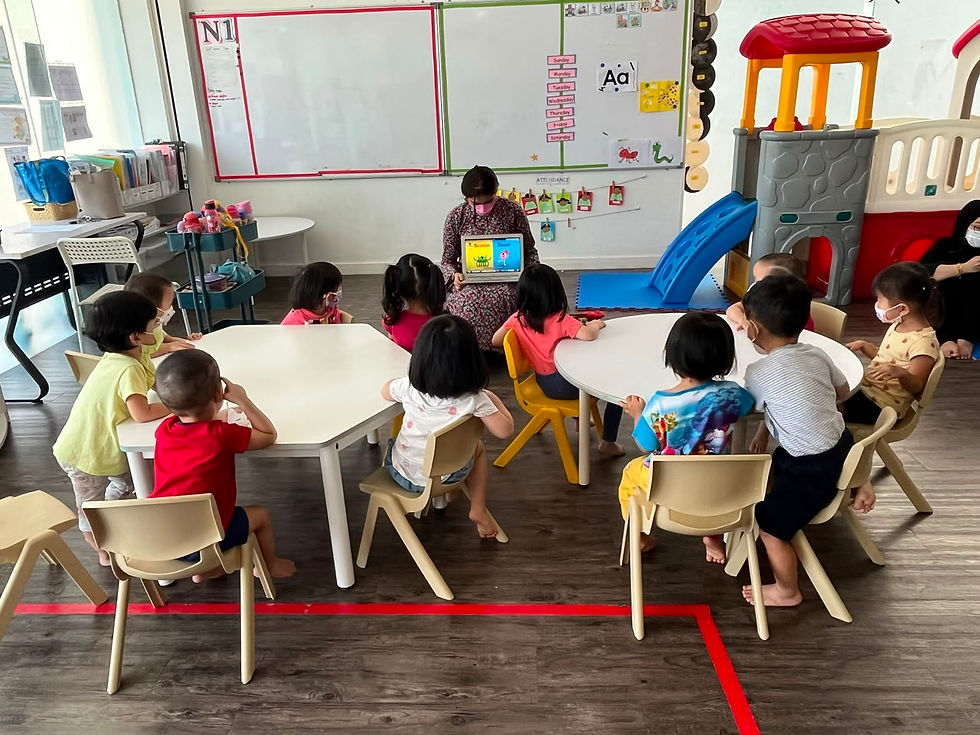
How Play-Based Learning Develops Language and Early Literacy
Language is the tool children use to understand teaching, build relationships and express what they know. Play creates reasons to listen and speak. Children negotiate roles, describe objects, retell experiences, ask questions and explain plans because communication helps the play continue.
The American Academy of Pediatrics links play with language development and the reciprocal interactions that support communication. NAEYC's developmentally appropriate practice guidance also places self-directed play, guided play, direct instruction and daily routines within an intentional teaching repertoire. (NAEYC, accessed 2026)
Stories Become Experiences Children Can Use
A story read aloud introduces vocabulary, sequence, characters and cause and effect. The learning deepens when children reenact the story, build its setting or invent another ending. They have to recall details and transform them into action.
For example, after hearing a story about a lost animal, children might create signs, draw a map and organise a search. The activity connects oral language, mark-making, symbols, spatial thinking and cooperation. Writing has a purpose because the sign communicates something within the shared project.
Mark-Making Becomes Meaningful
Early writing does not begin only with copying letters. It also grows through drawing, making lists, labelling constructions, writing pretend orders and recording ideas. These experiences help children understand that marks carry meaning.
Teachers can add explicit instruction when children are ready. They may model how to form a letter, notice a sound at the start of a name or point out how text moves across a page. The distinction is not play or teaching. High-quality practice uses both, choosing the method that fits the learning goal and the child.
Multilingual Interaction Supports Participation
Children may enter preschool with different home languages and different levels of confidence in the languages used at school. A responsive classroom uses gestures, objects, repetition, songs, stories and peer interaction to help children understand and participate.
Pitter Patter describes its approach as Play Inquiry Multilingual, including Bahasa Malaysia and Mandarin, and presents children as active constructors of knowledge. (Pitter Patter Early Learning Centre, accessed 2026) In practice, multilingual learning works best when language is connected to relationships, routines and meaningful experiences instead of isolated vocabulary drills.
How Play Builds Early Mathematics and Scientific Thinking
Young children meet mathematical and scientific ideas whenever they compare, count, predict, measure, sort and test. Play gives these ideas a visible purpose.
At a pretend cafe, children decide how many plates are needed. In water play, they compare volume. During block construction, they encounter balance, shape and symmetry. On a nature walk, they classify leaves and notice patterns. The teacher's questions turn activity into clearer thinking: "How do you know we have enough?" "What changed?" "Which container holds more?" "What could you try next?"
The What Works Clearinghouse practice guide Preparing Young Children for School draws on an expert panel and research review. Its recommendations include intentional support for social-emotional skills, executive function, mathematics, vocabulary and early literacy. (Institute of Education Sciences, 2022) The guide shows why an effective preschool programme needs both engaging experiences and purposeful teaching.
A 2022 systematic review and meta-analysis examined 39 guided-play studies, with 17 included in meta-analysis. It found advantages for guided play over direct instruction in early mathematics, shape knowledge and task switching, while finding no clear differences for several other outcomes. The authors also cautioned that studies varied in how guided play was defined and implemented. (Skene et al., Child Development, 2022)
The responsible conclusion is not that one method wins every learning goal. It is that guided play can be especially effective when teachers set a clear goal, preserve meaningful child choice and use prompts or modelling sensitively. Some knowledge still benefits from concise, explicit teaching. The child then needs opportunities to use that knowledge in different contexts.
How Play-Based Learning Supports Social and Emotional Readiness
Primary school brings a larger community, shared resources, changing expectations and unavoidable disagreements. Social and emotional readiness helps a child take part without needing an adult to solve every small difficulty.
Children Practise Cooperation
Shared play requires children to enter a group, propose an idea, listen to alternatives and coordinate actions. They may decide who uses a popular prop, how to divide materials or what rules their game will follow. These are not interruptions to learning. They are learning experiences with immediate consequences.
Teachers support this process by giving children usable language. Instead of solving every dispute, an educator might say, "Tell him what you need," or "What could both of you agree to?" The aim is not perfect harmony. It is growing competence in handling ordinary social tension.
Children Learn to Recognise and Regulate Feelings
Play can bring excitement, disappointment, uncertainty and pride. A caring teacher helps children name those feelings and choose safe responses. The child may pause, ask for help, try a different role or return after calming down.
These habits transfer to school tasks. A child who can tolerate a difficult puzzle is better prepared to face a challenging page. A child who can say, "I don't understand," is more able to benefit from teaching than a child who hides confusion or immediately gives up.
Children Develop a Sense of Belonging
NAEYC defines developmentally appropriate practice as a strengths-based, play-based approach to joyful, engaged learning that is responsive to children's cultural, linguistic and individual contexts. (NAEYC, accessed 2026) Belonging matters because children participate more freely when their experiences and identities are treated with respect.
Teachers can reflect children's family life in books, songs, role-play materials and classroom conversations. They can invite different ways of explaining an idea and help peers become curious rather than dismissive about differences. This prepares children to learn in a diverse primary-school community.

How Play-Based Learning Builds Physical and Practical Independence
School readiness also lives in the body. Children need stamina, coordination and enough independence to move through daily routines with confidence.
Outdoor play, climbing, balancing, dancing and ball games strengthen gross-motor coordination. Drawing, clay, threading, cutting and construction strengthen hand control and coordination used in writing, fastening clothing and managing learning materials. The purpose is not to force adult-like pencil work before a child's hand is ready. It is to offer varied, repeated movement experiences.
Practical routines are equally important. Children can learn to:
Put belongings in a consistent place.
Wash and dry their hands properly.
Open common food containers with appropriate support.
Pack away materials after use.
Put on or remove simple clothing items.
Use the toilet and communicate personal needs at an age-appropriate level.
Move from one activity to another using familiar cues.
A play-based classroom does not treat independence as a separate subject. Children practise it throughout the day. They collect materials for a project, return items, organise a pretend space and take responsibility for part of a group task.
What Is the Teacher's Role in Play-Based Learning?
The teacher's role is active, intentional and responsive. Play-based learning is not a period when adults step away and hope useful learning happens.
Teachers Prepare the Environment
Teachers select materials that invite more than one possible use, arrange spaces for different forms of play and consider what concepts children may encounter. They observe whether the environment encourages deep involvement or produces aimless wandering and conflict.
Teachers Observe Before Intervening
Observation helps a teacher understand what a child can already do, what interests the child and where support may extend learning. Entering too quickly can take ownership away. Waiting too long may leave a child stuck. Skilled teaching involves judging when to watch, when to ask and when to demonstrate.
Teachers Ask Questions That Extend Thinking
Useful prompts include:
"What do you notice?"
"What is your plan?"
"Why do you think that happened?"
"How could we find out?"
"Can you show me another way?"
"What could you say to your friend?"
These prompts do not test children for a single expected answer. They help children make their thinking visible and consider another possibility.
Teachers Teach Directly When It Helps
Direct teaching has a place. A teacher may explain a safety rule, model how to use scissors, introduce a letter-sound relationship or demonstrate a counting strategy. Effective play-based practice does not reject instruction. It avoids allowing instruction to replace the exploration, application and social interaction young children also need.
What Does School-Ready Play Look Like in a Preschool Day?
Parents may not immediately see the learning in a busy room. The table below connects familiar play experiences with the school-readiness abilities they can develop when teachers plan and guide them intentionally.
Play experience | What children may practise | Connection to primary school |
|---|---|---|
Pretend shop or cafe | Conversation, counting, roles, symbols and negotiation | Communicating, early mathematics and cooperative work |
Block construction | Planning, spatial language, balance and revision | Problem-solving, persistence and mathematical thinking |
Story reenactment | Sequence, vocabulary, memory and perspective | Listening comprehension, narrative and expressive language |
Art with open-ended materials | Choice, fine-motor control and representation | Hand control, planning and explaining ideas |
Movement games with rules | Inhibition, attention, coordination and turn-taking | Following instructions and self-regulation |
Inquiry project | Questioning, observing, recording and revisiting ideas | Learning how to investigate and use evidence |
Group clean-up | Classification, responsibility and shared routines | Independence and classroom participation |
The learning is strongest when experiences are revisited. A single building activity may be enjoyable. A sequence in which children plan, build, discuss, draw and improve a structure provides a richer record of growth.
How Parents Can Support the Transition to Primary School
Parents do not need to recreate school at home. Everyday routines and play can support readiness without adding pressure.
Keep predictable routines. Let your child know what happens before leaving home, at mealtimes and before bed. Predictability makes it easier to practise responsibility.
Give manageable responsibilities. Ask your child to pack one item, carry a small bag or help prepare a simple snack.
Read and talk daily. Pause to discuss characters, predict what may happen and connect the story to real life.
Play games with rules. Matching, movement and turn-taking games help children practise attention and coping with outcomes.
Invite problem-solving. Ask what your child could try before providing the answer.
Make room for drawing and meaningful writing. A shopping list, label or card gives marks a purpose.
Talk positively and realistically about school. Describe routines and new opportunities without promising that every moment will be easy.
Coordinate with the preschool. Ask what independence goals and learning habits teachers are currently supporting.
Avoid turning readiness into a performance. Repeated quizzes can make a child cautious about being wrong. Conversation, shared reading and playful practice allow adults to notice what the child understands and where gentle support is needed.
Common Misconceptions About Play and School Readiness
Misconception 1: If Children Are Playing, the Teacher Is Not Teaching
Intentional teachers make many decisions before, during and after play. They define learning goals, prepare materials, observe strategies, introduce vocabulary, model skills and document progress. The teaching may be less visible than a whole-class lecture, but it is not absent.
Misconception 2: Play-Based Learning Means No Structure
Young children benefit from predictable routines, clear boundaries and thoughtfully organised environments. Choice works best inside safe limits. A play-based day can include group meetings, stories, meals, outdoor time, small-group teaching and transitions while still protecting substantial time for exploration.
Misconception 3: Academic Skills and Play Are Opposites
Children can learn letters, sounds, numbers and concepts through playful contexts and brief explicit instruction. The real question is whether they understand and can use the skill, not whether it was first presented on a worksheet.
Misconception 4: Every Child Should Reach Readiness in the Same Way
Development varies. Language background, temperament, experience, interests and additional needs influence how a child participates. A strong programme observes the individual child and adapts support while keeping meaningful expectations.
Frequently Asked Questions
Can a Play-Based Preschool Prepare a Child Academically?
Yes. Purposeful play can develop early language, literacy, mathematics, scientific thinking and executive function. Strong programmes also use direct teaching when a specific concept or procedure needs clear explanation. Parents should look for evidence of both intentional planning and active child engagement.
Does My Child Need to Read Before Primary School?
Children enter primary school with different reading experiences and abilities. More useful foundations include interest in books, oral language, awareness that print carries meaning, growing sound awareness and confidence in attempting unfamiliar words. Follow the receiving school's expectations, but avoid replacing broad development with pressure to read early.
How Can I Tell Whether Play Has a Learning Purpose?
Ask teachers what they observed, what questions they introduced and how the experience may develop over several days. Look for children making choices, concentrating, talking, testing ideas and revisiting work. A clear learning purpose does not mean every child must produce the same product.
What If My Child Prefers to Play Alone?
Solitary play can be meaningful, especially when a child is deeply focused or still becoming comfortable. Teachers should also create gentle opportunities for shared play, such as pairing children around a common interest. The goal is growing social flexibility, not forcing constant group participation.
Should Parents Use Worksheets at Home?
An occasional worksheet is not inherently harmful, but it should not crowd out conversation, reading, movement, practical routines and play. If a worksheet causes repeated conflict or merely rehearses copying, choose a meaningful activity that targets the same idea.
How Long Does School Readiness Take to Develop?
School readiness develops over years, not during one final preschool term. Progress is often uneven: a child may show advanced language but need more support with transitions, or strong independence but less confidence in groups. Regular communication between family and educators helps identify the next realistic step.
Final Answer
How play-based learning prepares children for primary school is best understood as preparation for participation. Children learn to think, communicate, cooperate, regulate themselves and apply early concepts through experiences that matter to them. When teachers combine playful exploration with clear goals, responsive guidance and selective direct instruction, children gain more than isolated knowledge. They develop the habits and confidence needed to use that knowledge in a real classroom.


Comments